

I have led a Wednesday-night women's Bible study at my church for eleven years, usually with eight to ten women around my kitchen table. For most of that time I took notes in a spiral notebook and kept my Bible clean. Then, about three years ago, I decided I wanted to write in the margins of the text itself, and I started looking for a Bible that would hold up to daily use. What I found was the ESV Journaling Bible from Crossway, and it changed the way I study. If you have been thinking about writing, drawing, or praying in the margins of your Bible but you are not sure where to begin, this guide is for you.
Here is the honest part first. Bible journaling is not about making a pretty page. It is about slowing down long enough to let one verse sit with you. Some days I write a sentence. Some days I sketch a small flower in the margin. Some days I just underline and date the verse. All of it counts. The tools matter less than the habit, but the right tools do make the habit easier to keep, and that is where this guide comes in.
Start with a Bible that gives you room to write
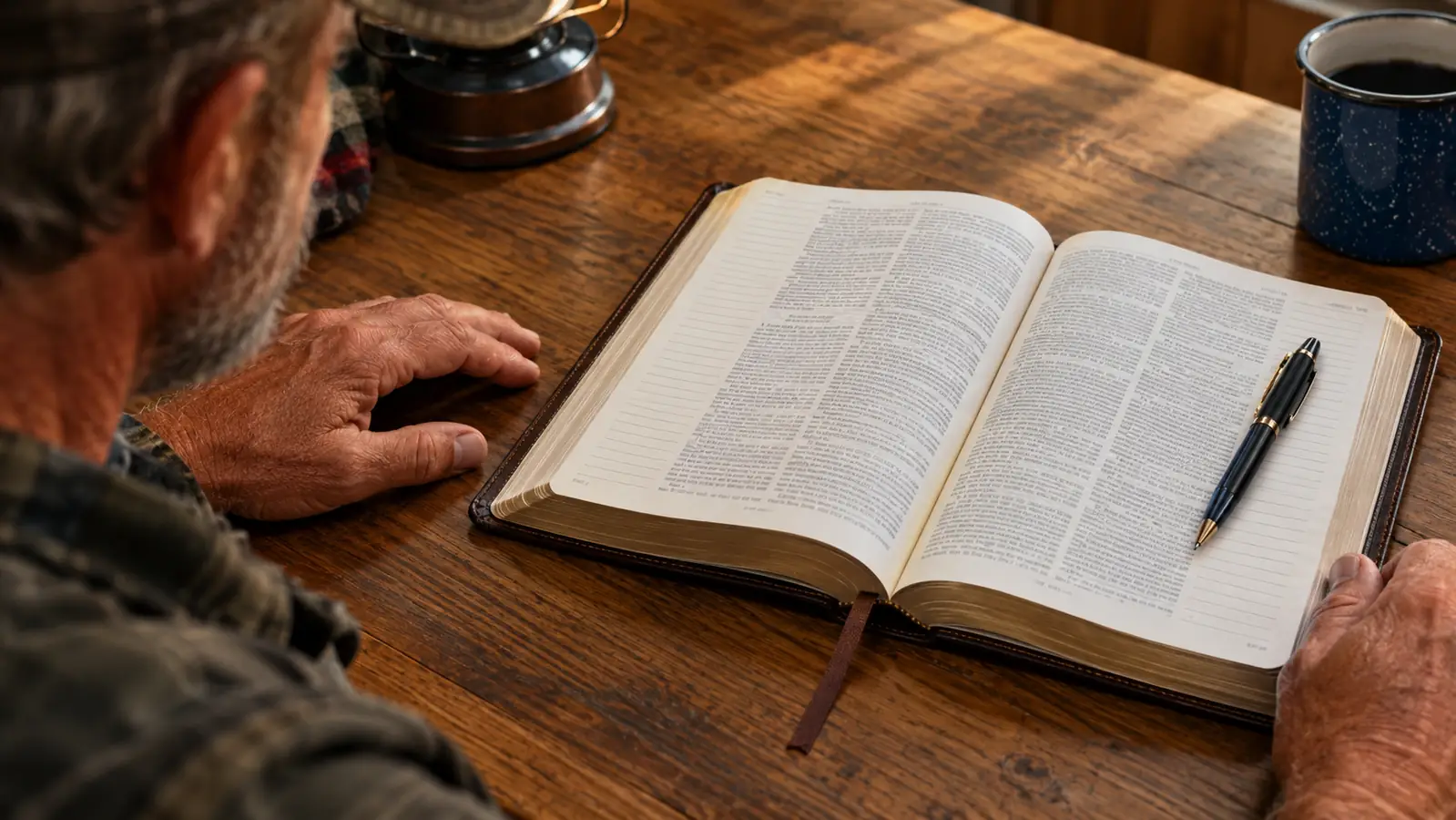
The ESV Journaling Bible from Crossway has wide, ruled margins made for writing, with the English Standard Version text you can trust for careful study. It is the Bible I reach for every morning.
Amazon Check Today's Price on Amazon →Step 1: Choose a journaling Bible that fits how you actually study
Before you buy anything, think about how you really read. Do you prefer a larger print size because you wear reading glasses, like I do? Do you want the full text of the Bible on the page, or are you willing to give up some verses for wider margins? Do you want a translation you already know well? These questions matter more than the cover design.
The ESV Journaling Bible from Crossway solves most of these questions at once. The English Standard Version is a word-for-word translation that reads with dignity, and it is the translation I have used in my study group for years. The pages are thick enough for pen without heavy bleed-through, and the margins are ruled, which means you get a built-in guide for straight writing. The cloth over board cover lies flat when open, which is essential when you are writing near the spine. I learned the value of wide margins the hard way. Before I ordered this Bible, I tried to write in my old study Bible, the one I have carried for years. Its margins are about the width of my little finger, and my handwriting is not small. I managed three weeks of cramped, slanting notes before I gave up.
You do not need the most expensive edition to start. You need a Bible with margins wide enough to write in, paper that can take a pen, and a translation you will actually read. That combination is harder to find than you would think, and it is the reason I recommend this one. The margins in the Crossway journaling edition are wide enough for a full sentence in my normal handwriting, and the ruled lines keep me from writing uphill. That sounds like a small thing until you have tried to write a prayer in a space the size of a postage stamp. It is the difference between a record you can actually read and a scribble you skip past.
Step 2: Gather only what you will really use
The internet will try to convince you that you need a dozen gel pens, washi tape, stencils, and a special desk lamp. You do not. When I started, I used a mechanical pencil and a fine-tip pen that I already owned. That was enough for the first month.
What I would add, in order of usefulness: a fine-tip pen that does not bleed through the page, a small ruler for straight lines, and a set of colored pencils if you want to add a little color without the risk of ink bleeding. I use a fine-tip pen for most of my margin notes, a pencil for underlining, and a small box of watercolor pencils for the occasional drawing. That is the whole kit. It fits in a pencil pouch.
One warning from experience. Test any new pen on a blank page at the back of the Bible before you write in the margins. Some pens bleed through more than others, and once ink is on the page, it is there. Last year I bought a pack of gel pens because the colors looked pretty in the listing, and the first one I tried bled straight through, leaving a shadow on the verse underneath. I read around that smudge for weeks, and the pack went to the back of a drawer. Now every pen gets the blank-page test before it goes near the text. My everyday fine-tip pen passed on the first try and has not bled once in the three years since, and the watercolor pencils have never bled at all. The test takes thirty seconds and costs nothing, and it is the difference between a margin you enjoy reading and a page you avoid. I have not bought a pretty pen since, and I do not miss them.
Step 3: Pick a simple method and stick with it for two weeks
The fastest way to give up on Bible journaling is to start with a complicated system. Do not try to color-code every theme or draw something on every page. Start with one simple method and do it for two weeks. My method is this: I read the passage for the day, then I write one sentence in the margin that captures what I want to remember. Sometimes it is a prayer. Sometimes it is a connection to something we discussed on Wednesday night. Sometimes it is just the date and a word.
The point is not to fill the margins. The point is to leave a record of what God was teaching you on that particular day. Here is a real example from my own pages. On a Tuesday morning last spring I read Psalm 46, and next to verse 10 I wrote: 'Be still first. Know second. I keep trying to reverse the order.' That sentence took less than a minute to write, and I have come back to it a dozen times since. Not every note is that tidy. Some of mine are just the date and a single word, like 'patience' or 'listen.' I can flip to almost any page and tell you what was happening that week just from the margin. The date matters as much as the word, because it anchors the note to a particular season of life. I have learned more from those small dated notes than from any notebook I ever kept. When I flip back through my journaling Bible, I can see the arc of my own study over the past three years, and that record has become more valuable to me than any single note.
If you want a slightly more structured approach, try the SOAP method: Scripture, Observation, Application, Prayer. Write the verse reference in the margin, then one line for each of the four parts. It is simple enough to remember and deep enough to keep you honest. But do not feel bound to any method. The goal is a habit, not a system.

Step 4: Make it part of your morning, not another task on your list
I study most mornings at my kitchen table with a cup of coffee. The journaling Bible lives on the table, open to where I left off, so I do not have to decide to journal. I just sit down, and it is already there. That small act of leaving the Bible open made a bigger difference than any technique I have tried. For me the quiet window is between six-thirty and seven, before Walt is fully awake and before the phone starts ringing. The house is still, the coffee is hot, and the kitchen light is good enough that I do not have to hunt for my reading glasses. On the mornings I sleep late, I do not skip the study, I just move it to the afternoon with a cup of tea. The habit survives the schedule changes because the Bible stays on the table either way. The open Bible on the table is a small daily reminder that does the deciding for me. Some mornings I only have time to read the passage and date it, and I have learned to count that as a win.
If mornings do not work for you, pick a time that does. The key is to attach the habit to something you already do, like eating breakfast or winding down at night. When my granddaughter visits, she likes to color in her own notebook while I write in mine, and that has become one of my favorite rhythms. You do not need a quiet hour. You need a consistent ten minutes.
One more practical note. Keep a pen with the Bible. If the pen is in another room, the habit will die a thousand small deaths. I keep a fine-tip pen in the ribbon of the journaling Bible, and I have a second one in my pencil pouch for when the first one runs dry.
Step 5: Let the margins serve your study, not the other way around
The greatest risk with Bible journaling is that it becomes an end in itself. You start to worry about making the page beautiful, and you stop paying attention to the text. I have caught myself doing this more than once. When I notice that I am more concerned with my lettering than with the verse, I take a break from drawing and go back to writing plain sentences.
The margins are a tool for study, not a scrapbook. If a page stays empty, that is fine. If a page has one word written in the margin, that is fine too. The Bible is not a coloring book, and it is not a diary. It is the Word of God, and the journaling is just my way of paying attention to it.
This is also the advice I give the women in my study group when they ask about journaling. Start small. Do not compare your margins to anyone else's. And remember that the goal is to know Scripture better, not to produce a work of art. The ESV Journaling Bible from Crossway gives you the space to do that, but the space is only useful if you actually use it.
What Else Helps
A few things have made journaling easier for me over the years. A good reading light matters more than I expected, especially now that I wear reading glasses. I use a small clip-on book light in the evenings, because the lamp beside my chair throws a shadow right across the page. A small lap desk helps when I want to study in a chair instead of at the table. And a simple bookmark or ribbon keeps me from losing my place, which sounds minor but makes a real difference.
If you are leading a small group, you might also consider getting a journaling Bible for each person who wants one and working through a passage together. The women in my group who started journaling say the same thing: writing in the margins makes them notice details they would have skimmed past. That is the real payoff, and it does not require any special talent.
The margins are a tool for study, not a scrapbook. If a page stays empty, that is fine. If a page has one word written in the margin, that is fine too.
The Bible I reach for every morning
If you are ready to start writing in the margins, the ESV Journaling Bible from Crossway is the one I recommend. Wide ruled margins, thick paper, and a translation that holds up to careful study.
Amazon Check Today's Price on Amazon →