

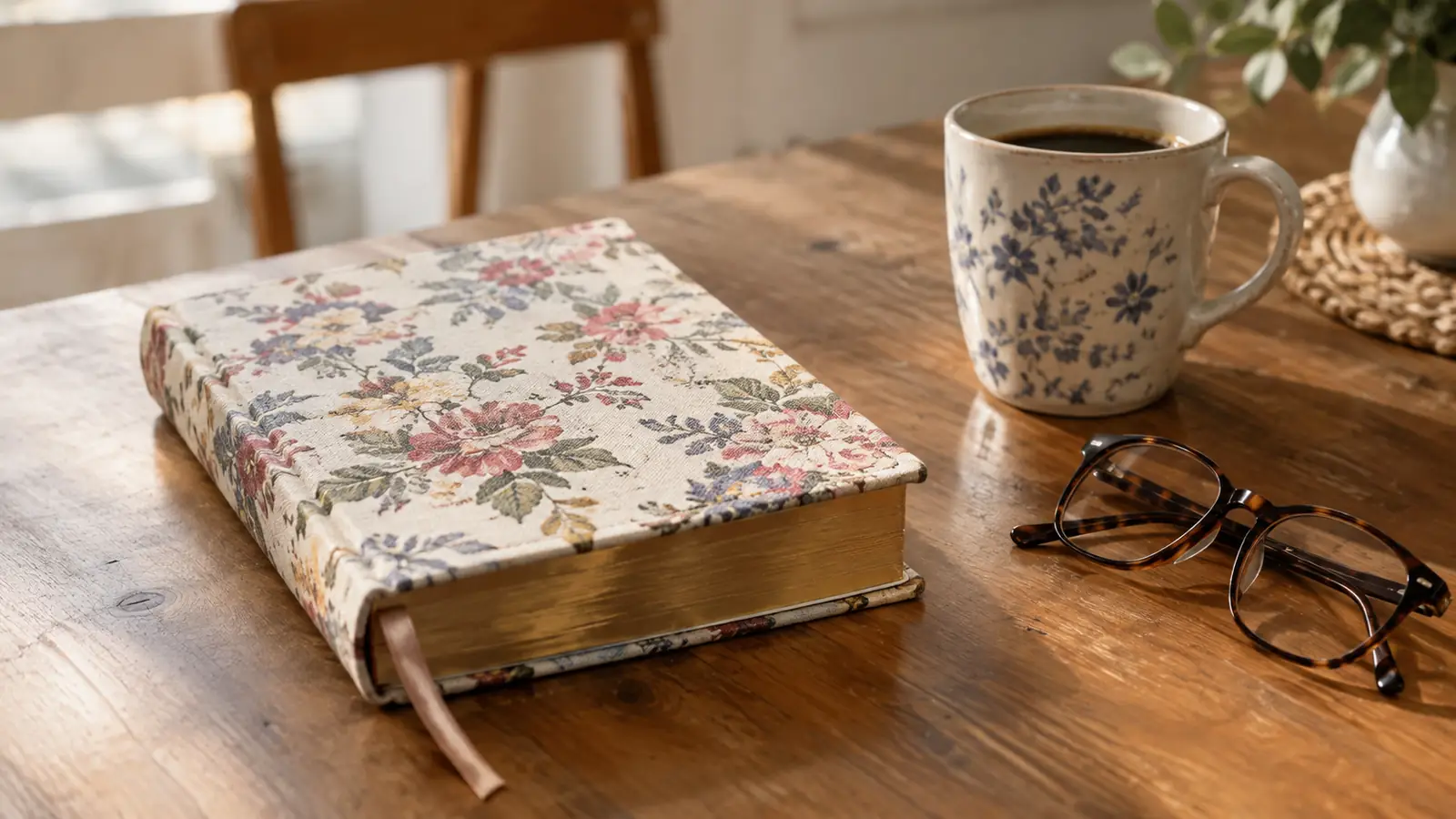
I have spent the last few years doing my morning study in the margins of a Crossway ESV Journaling Bible, the cloth over board edition with the flowers on the cover. It sits on my kitchen table next to my coffee mug and my reading glasses every day. But I have also led a Wednesday night women's study for eleven years, and over that time I have watched women read from the NIV and fall in love with scripture in a way that is hard to argue with. So when someone asks me which journaling Bible to buy, I do not have a one word answer.
The short answer is this: the Crossway ESV Journaling Bible is the one I would choose for personal study, because the paper and the margins are made for writing. The NIV Journaling Bible is the one I would hand to someone who wants to read scripture aloud or is new to Bible study, because the language flows more naturally. Neither is wrong. The right choice depends on how you study, where you study, and who is going to be reading with you.
Why I Decided to Compare These Two
A few weeks ago, one of the women in my study asked me to help her pick a Bible for her daughter, who had just started college. Her daughter is an English major who wanted to start journaling through scripture, but she did not know whether to choose the ESV or the NIV. I told her the truth: I use the Crossway ESV every morning, but I have seen the NIV change the way people read. She wanted a Bible she could write in during her quiet time and still read aloud at her campus ministry, and that gave me pause. I sat with the question for a week, reading the same passages in both translations every morning before I could give her an honest answer. That conversation is what made me want to put the two side by side in a way that is honest about both.
I am not a scholar. I am a retired school librarian who has spent eleven years around a kitchen table with eight or ten women, reading scripture and talking about what it means. I know what holds up when you use it every day, and I know what gets left on the shelf. That is the perspective I am bringing to this comparison.

What I Look For in a Journaling Bible
Before I talk about the two Bibles themselves, it helps to know what I am actually looking for. A journaling Bible has to do three things well. It has to have margins wide enough to write in, paper that does not bleed through, and a translation that makes me want to keep reading. If any one of those is missing, the Bible will end up back on the shelf.
I wear reading glasses, so print size matters to me. I also like a Bible that lays flat when I open it, because I am usually writing with one hand and holding my coffee with the other. And because I have taken up watercolor and hand lettering over the last few years, I care about whether the paper can handle a little more than a ballpoint pen. I learned that the hard way a few years ago, when a brush pen bled through two pages of a notebook I loved and ruined the verse I had been copying. Since then, I test the paper before I fall in love with a cover.
Those are the standards I used when I compared the Crossway ESV Journaling Bible with the NIV Journaling Bible. I spent several weeks using each one for my morning reading, my sermon notes, and my Wednesday night study prep. I also paid attention to how they felt in my hands and how often I reached for them.
| Crossway ESV Journaling Bible | NIV Journaling Bible | |
|---|---|---|
| Translation style | Word for word, stays close to the original Hebrew and Greek | Thought for thought, reads naturally in modern English |
| Journaling margins | Wide, consistent margins on every page, made for notes and art | Wide margins in most editions, but they can vary by printing |
| Paper quality | Thicker paper that handles pen and light watercolor without much ghosting | Good paper, but some editions are thinner and show ghosting |
| Reading aloud | Precise, but the formal tone can feel stiff | Smoother and more natural for group reading |
| Cover | Cloth over board, flexible, lays flat, pretty floral design | Hardcover and imitation leather options, also durable |
| Best for | Personal study, journaling, hand lettering | Group reading, new believers, everyday reading |
How I Tested Both Bibles
To be fair to both Bibles, I used each one for a full week of morning study. I chose the Gospel of John for the first week and the Psalms for the second, because those are the books I know best and the ones where I would notice a difference in how the words flow. I read the same passages in both, took notes in the margins, and paid attention to how often I had to stop and think about the reading. On the third morning, I read Psalm 23 in both translations back to back and wrote down how each one landed. The NIV felt like a prayer I already knew, while the Crossway made me slow down and sit with each phrase. I also carried each one to church on Sunday and used it during the sermon.
I tested the paper with a ballpoint pen, a fine tip gel pen, and a small watercolor brush. I tested the binding by opening each Bible to the middle and seeing whether it stayed flat. I tested the print size by reading in low light, which is how I actually read most mornings before the sun is fully up.
I am not a professional reviewer, so I did not measure anything with instruments. I just paid attention to what made me want to keep reading and what made me want to close the book. That is the test that matters for most of us.
A Note on Translation Philosophy
The biggest difference between these two Bibles is not the cover or the margins. It is the translation philosophy. The ESV uses a word for word approach, which means the translators tried to stay as close as possible to the original Hebrew and Greek. The NIV uses a thought for thought approach, which means the translators focused on what the passage means in natural modern English.
Neither approach is better. They are just different tools. If you want to study the exact words of a verse, the ESV gives you a clearer view of the original structure. If you want to understand the big picture of a passage quickly, the NIV gets you there faster. That is why I use the ESV for my own study and reach for the NIV when I want to read a long section aloud.
Where the Crossway ESV Journaling Bible Wins
The first thing I noticed when I started using the Crossway ESV Journaling Bible was the paper. I write with a fine tip pen, and I have also tried a little watercolor in the margins. The pages hold up. There is some ghosting if you press hard, but far less than I have seen in other journaling Bibles. For someone who wants to take notes during a sermon or paint a small flower next to a verse, that matters.
The margins are the other reason I keep coming back. They are wide and consistent from the top of the page to the bottom, which means I can write a full thought without running out of room. The cloth over board cover is flexible and lays flat when I open it, so I do not have to hold the pages down with one hand while I write with the other. And the floral design is pretty without being fussy. It looks like something I would leave on my kitchen table, not hide in a drawer.
I also appreciate the way the Crossway ESV handles the text itself. The English Standard Version is a word for word translation, which means it stays close to the original Hebrew and Greek. That is helpful when I am doing a word study or trying to understand a passage that I have read a hundred times. The formal tone takes a little getting used to, but it rewards slow reading.
Where the NIV Journaling Bible Wins
The NIV has one clear advantage in my experience: it is easier to read aloud. The sentences flow the way we actually speak, and that makes a difference when you are reading a passage to a group of women who are hearing it for the first time. In our Wednesday night study, when we read from the NIV, the women nod along. When we read from a more formal translation, they sometimes have to stop and untangle the sentence.
The NIV is also a gentler place to start for someone who is new to scripture. The language is familiar and inviting, and that can be the difference between a Bible that gets picked up and a Bible that stays on the shelf. If your goal is to read through a book of the Bible in a month, or to read a Psalm before bed, the NIV Journaling Bible is a wonderful companion. It still has wide margins for notes, just not quite as consistently wide as the Crossway in every printing.
I have handed the NIV to more than one woman who told me she had never been able to get into Bible reading. One of them was a retired nurse in her seventies who had been coming to our study for a month without saying much. She told me the NIV was the first Bible she had ever owned. Within a week, she was texting me at ten o'clock at night about a verse that had stopped her in her tracks. There is something about the natural rhythm of the NIV that makes scripture feel less like a textbook and more like a conversation. For a new believer, that is a gift.
The best journaling Bible is the one you actually open in the morning. For me, that is the Crossway. For a friend who reads aloud, it might be the NIV.
Start journaling in the Crossway ESV Journaling Bible
If you want wide margins, thick paper, and a cover that lays flat on the kitchen table, this is the one I reach for every morning. Check today's price on Amazon and see if it fits the way you study.
Amazon Check Today's Price on Amazon →Who Should Buy Which
Buy the Crossway ESV Journaling Bible if you are a note taker, a hand letterer, or someone who wants to dig into the original meaning of words. The formal translation rewards slow reading, and the wide margins give you room to write what you find. It is also a lovely gift for a friend who already loves scripture and wants a beautiful place to record her thoughts.
Buy the NIV Journaling Bible if you read aloud often, if you are new to Bible study, or if you want a translation that feels like a conversation. It is the Bible I would hand to my granddaughter on her first day of college, because she would actually read it. The journaling space is still there, just in a translation that flows.
And if you are still torn, here is my advice: choose the translation first and the features second. A journaling Bible is only useful if you read it. The Crossway ESV is the better made book. The NIV is the easier read. You will not go wrong with either one, but you will know which one is right for you after you spend a few minutes with both.
My Bottom Line
If I had to pick one Bible to keep on my kitchen table for the rest of my life, it would be the Crossway ESV Journaling Bible. The paper, the margins, and the cover all work together to make writing in the margins a joy. I have filled pages with notes and small paintings, and the book still looks beautiful.
But I would not hand the Crossway to everyone. For a new believer, or for someone who reads scripture aloud in a group, the NIV Journaling Bible is the better choice. The translation is more inviting, and that matters more than any feature. The right Bible is the one that gets read.
See the Crossway ESV Journaling Bible on Amazon
Whether you choose the ESV or the NIV, the important thing is to keep showing up. If you want the one I use every morning, the Crossway is waiting.
Amazon Check Today's Price on Amazon →