

I have led a women's Bible study at my church for eleven years now, and for most of that time I studied from the same worn study Bible I carried through grad school. When I decided to try a journaling Bible, I picked up the ESV Journaling Bible from Crossway because it had the translation I trusted and a cover that made me want to leave it out on the table. Two years later, I have strong opinions about what it does well and what nobody mentions in the product photos. This is the honest version.
The Quick Verdict
A beautiful, sturdy journaling Bible with genuinely wide margins and a readable text size. The paper handles pen and light watercolor better than most. Just know the cover is delicate, the pages are thin, and the single-column layout means the margins are the star, not the study notes.
Amazon Check Today's Price →The ESV Journaling Bible that has earned a permanent spot on my kitchen table
After two years of daily use, this is the journaling Bible I reach for every morning. See today's price on Amazon and decide if it belongs on your table too.
Amazon Check Today's Price on Amazon →How I've Used It
I bought mine on a Tuesday in late April, two years ago, the week after I saw a friend's journaling Bible at our Wednesday night group and could not stop turning the pages. I had been practicing hand lettering on index cards for a year, and the cards were piling up in a drawer. I wanted a place to put the verses where they belonged, next to the text. My old study Bible had served me fine for thirty years, but it had no room for writing, and I was tired of losing the index cards.
The first week I owned it, I barely wrote in it. I was nervous. I had never written in a Bible before, and the idea of making a mistake in the margin of a page I would read for the rest of my life felt permanent. So I practiced on a scrap of paper, copying the verse I wanted to write until I liked the way it looked. Then, on a Saturday morning, I wrote it in the margin with a fine-tip pen. That first verse is still there, slightly crooked, and I have never once regretted it.
After that, I used it every morning at my kitchen table, usually with a cup of coffee and my reading glasses, and I took it to our Wednesday night group almost every week. I have written in it with ballpoint pens, gel pens, fine-tip markers, and a small watercolor set. I have spilled coffee near it, dropped it once on the tile floor when I reached across the table for the creamer, and carried it in a canvas tote through two Tennessee summers where the humidity made the pages feel slightly damp no matter what I did.
What I did not do was treat it like a museum piece. I wanted a Bible I could actually use, and I used it hard. That is the standard I am measuring it against.
What Nobody Tells You Before You Buy
The first thing nobody tells you is that the cover is not as sturdy as it looks in the photos. The cloth over board binding is beautiful, and the floral design is what sold me, but it is soft and a little delicate. I noticed the first sign of wear about eight months in: the bottom right corner of the front cover began to soften and round, the way a paperback does after it has been in a purse too long. Then, sometime in the second year, a faint ring appeared on the back cover. I never set a mug directly on it, but the cloth seems to pick up moisture from the table. The stain is pale, and I am probably the only one who notices it, but it is there. It still looks lovely, and I would not trade it for a sturdier cover, but if you are hoping for something that will shrug off being tossed in a bag, this is not that Bible.
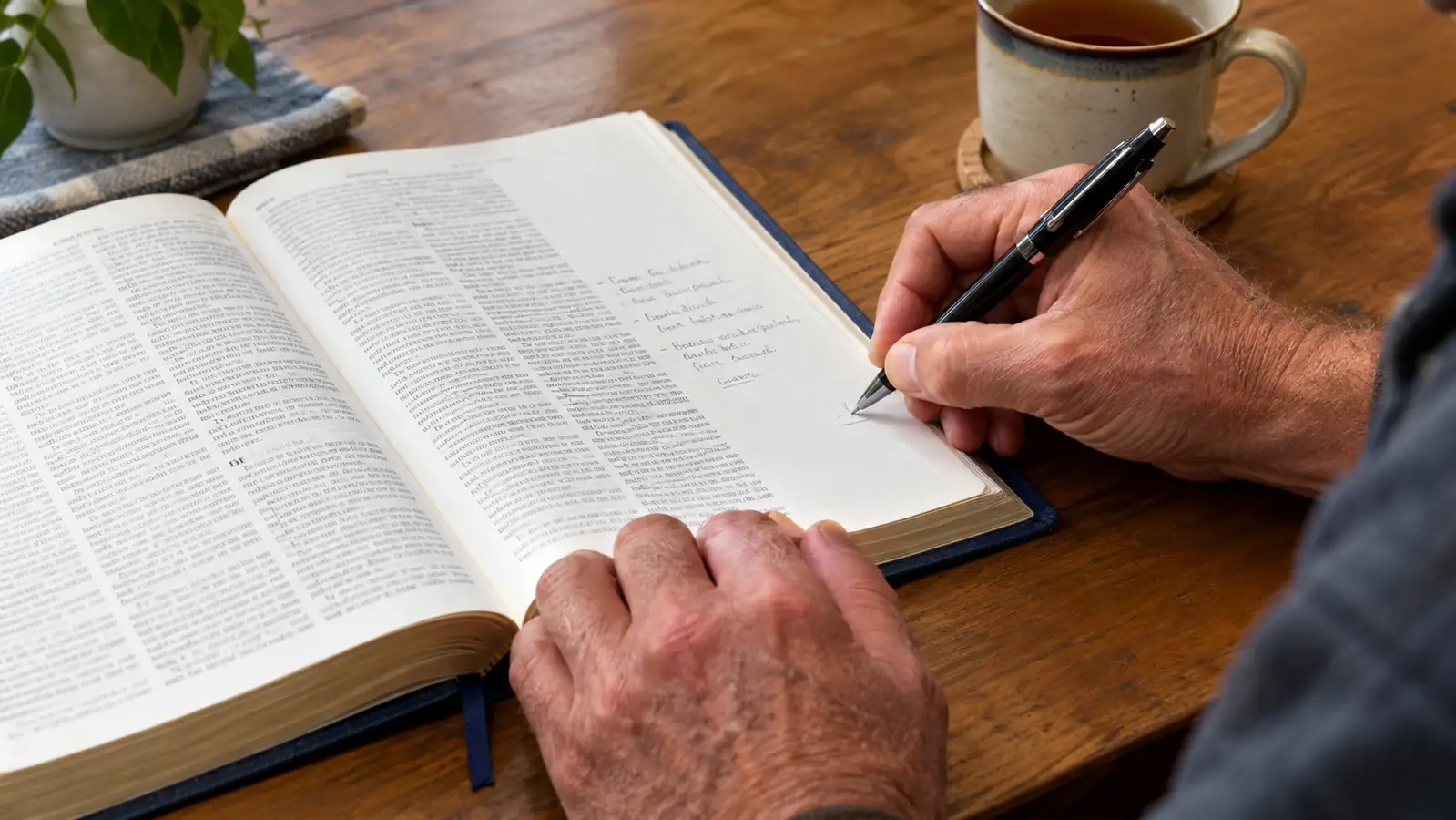
The second thing is the paper. The pages are thin, which is normal for a Bible this size, but it matters more here because the whole point is writing in the margins. With most ballpoint pens, you can see a faint shadow of the writing on the other side of the page. It does not bleed through, but it is visible if you are looking for it. I found this out the hard way with a fine-liner I loved, a 0.4mm pen that wrote beautifully and shadowed badly. I used it for a week, then went back and looked at the back of each page. Every single one showed a ghost of the writing. I switched to a gel pen with a 0.5mm tip, and the shadowing stopped almost entirely. Fine-tip markers are better still. I learned to test every new pen on a page near the back before I committed to it in a margin, and I would tell anyone else to do the same.
The third thing is the layout. The text is single-column, which is lovely for reading, but it means the margins are wide and the text block sits in the middle of the page. That is exactly what you want for journaling. What you do not get is any study notes, cross references, or concordance. This is a bare text Bible with room to write. The first time this mattered to me was a Wednesday night in October, when one of the women asked where else in scripture the same Greek word appeared. I flipped to the back of my journaling Bible out of habit and found blank pages. My old study Bible would have had a cross reference right there. I keep a small notebook for that kind of question now, but it took me a few months to remember to bring it.
The paper handles pen and light watercolor better than any Bible I have owned, but every pen needs a test run before it touches a margin.
The Margins Are the Whole Point
The margins in the ESV Journaling Bible from Crossway are genuinely wide. I measured mine out of curiosity one morning instead of reading, which tells you something about where my head was. The outer margin is about two and a quarter inches, which is enough for a verse reference, a short prayer, and a small sketch without feeling crowded. The inner margin is narrower, closer to three quarters of an inch, which means you will do most of your writing on the outer edge. That is worth knowing before you start, because it changes how you plan your notes. I learned to put the date at the top of the outer margin, a line of sermon notes or a verse reference in the middle, and a small drawing or a prayer request at the bottom. It is a system I made up, but it has kept the margins from turning into a jumble.
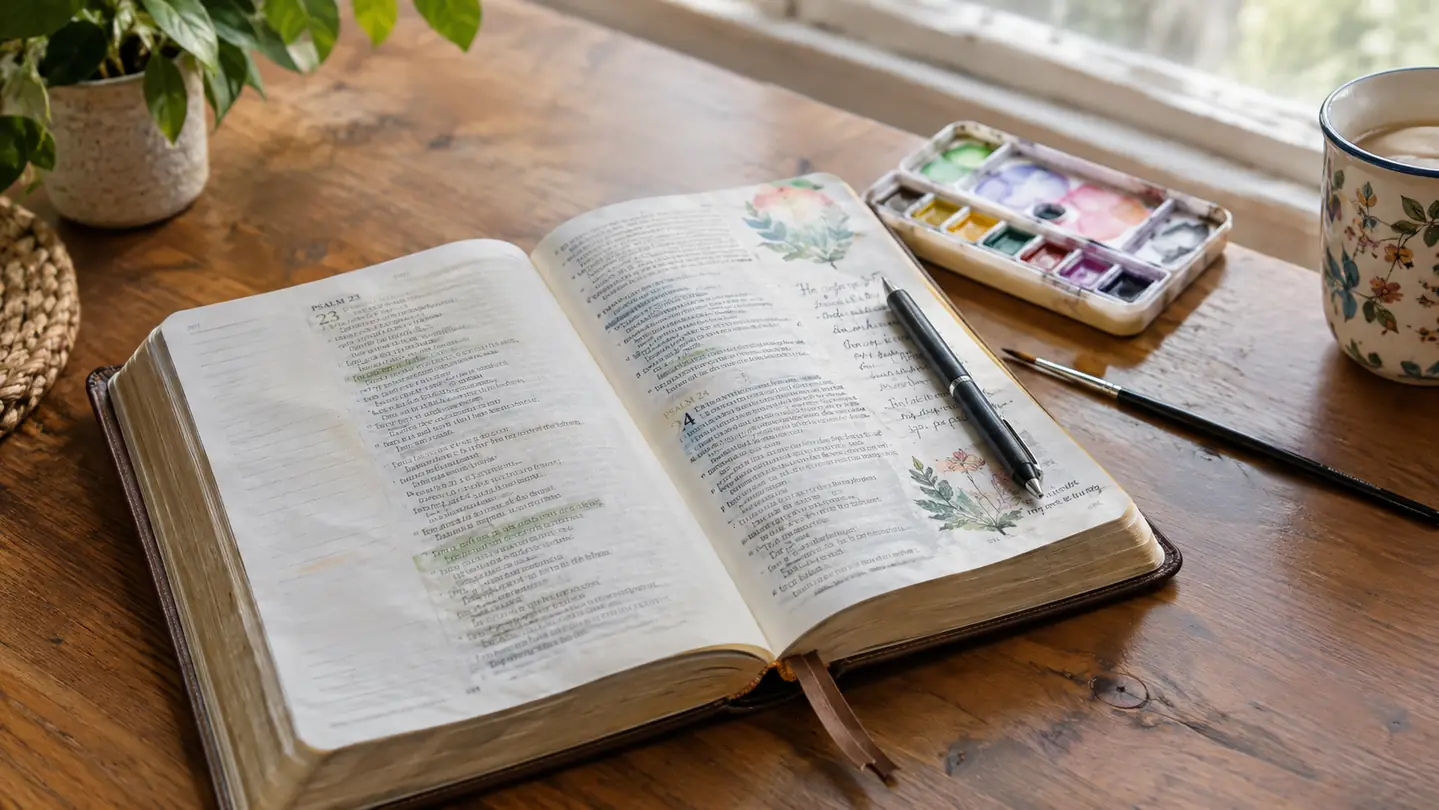
I have filled margins with sermon notes on Sunday mornings, with questions I wanted to bring to our Wednesday night group, and with watercolor washes that I let dry before closing the Bible. The paper does not buckle badly with light watercolor, which surprised me. The first time I tried it, I was sure I was about to ruin the page. I had a small travel set with a tiny brush, and I wet the brush, touched it to the pan, and painted a pale wash behind the word 'peace' in Philippians. Then I sat there with the Bible open, waiting for the page to wrinkle. It did not. The page stayed flat, and the wash dried to a soft color that did not shadow through to the other side.
I have done this dozens of times since, always with the same rule: a little water, a small brush, and patience. I let the page dry completely before I close the Bible, usually ten minutes with the book lying open on the table while I refill my coffee. Heavy washes would be a problem, and I would not recommend wet-on-wet painting in a Bible, but for light color in the margin, it works. The hand lettering has been the bigger part of my practice, and the wide outer margin gives me room to write a verse in large, slow letters without crowding the text. I am not good at it yet, but the margin does not care, and neither does the text.
How the Translation Reads
The ESV is the translation I have read for years, so I did not expect any surprises, but reading it in this layout was different in a good way. The single-column format with generous margins makes the text feel less dense. I found myself reading longer passages without stopping, because there were no footnotes or cross references pulling my eye away. One morning in the first month, I read all of Psalm 119 straight through, something I had never done before. In my old study Bible, I would have stopped at every cross reference, flipped to the bottom of the page, then flipped to another passage, and by the time I found my way back I would have lost the thread. Here, the text just continues. For a slow reader like me, that is a real benefit, and it is the reason I reach for this Bible even on mornings when I am not planning to write in it.
The type size is another thing nobody tells you. It is readable, but it is not large print. I would compare it to the print in a standard paperback novel, a little smaller than the print in most new books. I wear reading glasses for close work, and with them on, the text is perfectly comfortable. Without them, I would struggle, and even with them I notice that the evening light in my kitchen is not enough. I have to turn on the lamp over the table for evening reading, which I never had to do with my old study Bible because the print was larger. If you do not wear glasses but you find yourself holding books at arm's length, you will want to check the type size in person before you buy. Crossway makes a large print journaling Bible, and that might be the better choice for you. I have thought about switching, but I have two years of notes in this one, and I am not starting over.
What It's Like to Write in It Every Day
I have kept up a daily habit of writing one verse in the margin and a short prayer next to it. Some days it is a sentence. Some days it is a small watercolor wash. The routine has become the part of my morning I look forward to most, and the Bible itself makes that easy. It lies flat when I open it to most pages, which is essential when you are writing with one hand and holding the page with the other. I noticed this in the first week, and I have appreciated it every single morning since. My old study Bible never lay flat; it always wanted to close itself, and I had to weight the pages with whatever was on the table.
The binding has held up well through two years of daily opening and closing. There are a few pages where it is a little stiff, usually near the front and back, and I have to hold them open with one hand. It is not a dealbreaker, but it is worth knowing if you plan to write in the first chapters of Genesis or the last chapters of Revelation. I have written in both, and I can tell you from experience that the stiffness does not go away with use. It just becomes something you work around.
The habit itself has changed how I read. Before, I read a passage and closed the Bible. Now I read a passage and ask myself which verse I would want to keep. That single question has slowed me down in the best way. Some mornings I read three chapters and write nothing because nothing stood out. Other mornings I read one verse and write a page of notes in the margin. The Bible does not care either way. It just lies there, open, waiting.
What I Liked
- Genuinely wide outer margins that fit verse references, prayers, and small sketches
- The cloth over board cover is beautiful and the floral design makes it a pleasure to leave out
- Paper handles fine-tip pens, gel pens, and light watercolor without bleeding through
- Single-column ESV text is clean and readable, especially with reading glasses
- Lies flat for writing in most places, which matters more than I expected
- Sturdy binding that has survived two years of daily use and a drop on tile
Where It Falls Short
- The cover is softer and more delicate than the photos suggest, and it shows wear
- No study notes, cross references, or concordance, so it is not a study Bible
- Thin pages show a faint shadow from ballpoint pens, so you need to test pens first
- Type size is not large print, and readers without glasses may find it small
- Inner margins are narrow, so most writing has to happen on the outer edge
Who This Is For
This Bible is for someone who wants to write in their Bible and wants room to do it well. If you are a slow reader who likes to underline and jot a thought in the margin, if you are learning hand lettering and want a beautiful place to practice, or if you are a small group leader who wants to keep questions and prayer requests next to the text, this is a wonderful tool. It is also a lovely gift for a recent graduate or a new believer, because it invites them to make the Word their own.
Who Should Skip It
If you need study notes, cross references, and a concordance in the same volume, this is not the Bible for you. If you want something you can toss in a backpack without thinking about it, the delicate cover will frustrate you. And if you do not wear glasses but find small print hard to read, look for the large print edition instead. I would also skip it if you are the kind of person who writes in pen and never tests it first, because the paper will punish that choice with shadowing.
Ready to make the margins your own?
The ESV Journaling Bible from Crossway is the one I reach for every morning. Check today's price on Amazon and see if it earns a place on your kitchen table.
Amazon Check Today's Price on Amazon →