

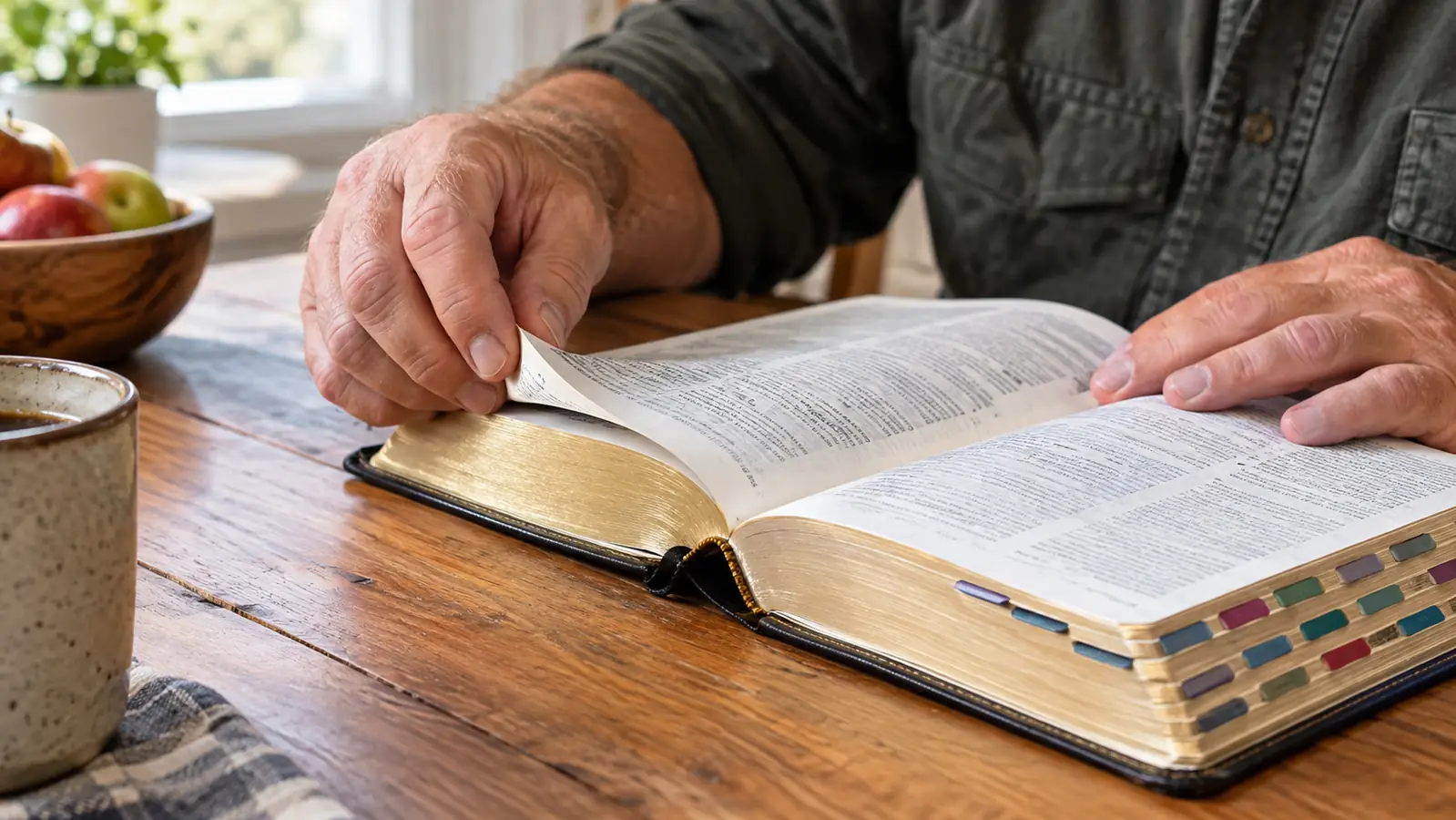
The first time I tried to find the book of Haggai in front of eight women, I gave up after a few seconds and said, 'Let's just read from the page I marked.' Nobody blinked. But I noticed, that night, how often our study paused while someone riffled through thin pages hunting for a book. I had told myself for years that Bible tabs were for people who could not find their way around scripture, the way I told myself I did not need reading glasses. Then I spent a Tuesday morning with a set of Mr. Pen tabs, a cup of coffee, and my old study Bible at the kitchen table, and I learned what the listing photos do not tell you.
This is not a review that pretends the tabs changed my spiritual life. They are paper, adhesive, and lamination, and that is exactly why I like them. What they changed is the mechanics of study: the small friction of finding a book, the pause in a conversation, the moment of embarrassment when you cannot lay a hand on 1 Timothy. I have used these tabs for months now, on a Bible that goes with me to the table every Wednesday night and most mornings. Here is what I wish someone had told me before I started.
The Quick Verdict
A practical set of laminated tabs that makes finding any book nearly automatic, once you accept that applying them takes a patient half hour and a steady hand.
Amazon Check Today's Price →Find Any Book in Seconds, Not Minutes
If you have ever paused a study to hunt for a book, the fix is embarrassingly simple. The Mr. Pen set covers all 66 books of the Bible with a few extras left over, and it has stayed put on my Bible for months.
Amazon Check Today's Price on Amazon →How I've Used It
I applied the tabs on a Tuesday morning in October, when the light on the kitchen table was good and I had a full hour before the grandkids came over. I put on my reading glasses, wiped the edge of the page with a dry cloth, and laid out the tabs in order. The sheet they come on is printed with the book names, so you can find each tab before you peel it. That sounds obvious, but it is the difference between a calm job and a frustrating one.
My method, for anyone who wants it: start with Genesis and work forward, one book at a time. Peel the tab, hold it by the edge so the adhesive does not touch your fingers, and line it up so the printed name sits just above the edge of the page. Press from the center of the tab outward. If you get one crooked, you can lift it gently in the first few seconds and try again. After that, the adhesive sets, and you should leave it alone.
It took me about twenty-five minutes for all sixty-six books, plus a few extra tabs I used for the maps in the back of my Bible. I will be honest: my hands are not as steady as they were twenty years ago, and I had to redo three tabs. None of that mattered. By lunchtime the job was done, and by Wednesday night I had already used the tabs a dozen times in my morning reading.
What the Listing Doesn't Tell You About Applying Them
The listing shows a finished Bible with neat tabs in a row, which makes the job look like it takes five minutes. It does not. Here is what nobody tells you: the tabs are small, the adhesive grabs quickly, and your fingers are bigger than the space you are working in. If you try to apply them in poor light or while you are half-watching television, you will get crooked tabs and a bad mood. This is a sit-down, both-hands, reading-glasses job.
The other thing the listing does not tell you is that the tabs are quieter than the photos suggest. The boho design is softer and less busy in person, which is a relief. I was worried the edge of my Bible would look like a craft project. It does not. The names are printed clearly, and at arm's length I can read them without my glasses, which is more than I can say for some sets I have seen at the Christian bookstore.
One more honest note about application. The sheet the tabs come on is sturdy, and the tabs peel off cleanly, but the extras are easy to lose. I set mine in a small dish on the table while I worked, and I still managed to drop one on the floor. It picked up a bit of dust, but a quick wipe and it was fine. Work over a table, not a lap, and you will save yourself the trouble.
What Nobody Tells You About How They Hold Up
Four months of weekly use is not a lifetime, but it is long enough to learn a few things. The lamination is the feature that earns its keep. My Bible gets carried to the kitchen table, the church fellowship hall, and sometimes the back porch. The tabs have been bent, pressed, and caught in the pages, and the edges have not curled or split. The names are still legible, which matters to me because I read with glasses and I refuse to squint at a tab.
The adhesive is the other surprise. I expected at least one tab to peel by Christmas. None have. The only wear I can find is on the tabs near the center of the Bible, where the cover presses hardest when the Bible is closed, and even those lie flat. The one thing I have learned to do is close the Bible gently. If you slam it shut, the tabs at the edge will catch on each other and bend. That is user error, not a product flaw, but it is real.
Here is a tradeoff nobody mentions in the reviews. The tabs add a little thickness to the edge of the Bible, and for the first week that felt strange under my fingers. I would reach for a page and feel the tabs before I felt the paper. By the second week I stopped noticing. If you are the kind of person who is bothered by any change to a familiar book, give yourself a few days before you decide.
And one honest limitation: the tabs do not make you faster if you do not know your way around the Bible. They make finding a book quicker, but you still need to know that Titus comes after 2 Timothy and before Philemon. What they actually do is remove the fumbling, which for a study leader is most of the battle.
Four months in, every tab is still stuck to the same page, and I have not once apologized to the group while hunting for a book.
The Real Difference at Our Wednesday-Night Table
The honest measure of any study tool is whether it changes how the group moves. Before the tabs, our Wednesday nights had a familiar rhythm: we would eat together, open our Bibles, and then someone would ask where a book was. Usually it was me. I have led this study for eleven years, and I still had to think before I could put a finger on Habakkuk or Zephaniah. The tabs did not make me a better reader of scripture. They made me a faster one, and that speed changed the feeling in the room.
The first Wednesday after I applied them, I turned to the night's passage without a pause, and one of the women said, 'You have tabs now.' A few of them leaned over to look. By the next month, three of them had ordered their own sets. That is the quiet way these things spread, not because anyone preached about them, but because the difference was visible in how smoothly the study ran.
For my own morning reading, the change was smaller but just as real. I used to read the same few books over and over because they were easy to find. With tabs, I have been turning to books I have not visited in years, like Amos and 1 Chronicles. The tabs lowered the cost of trying something unfamiliar, and that is a genuine benefit for anyone whose study has settled into a rut.
The other change was in the women who were newer to the Bible. One of them told me she had been embarrassed for months about not knowing where books were, and the tabs let her follow along without asking. That is a small mercy, but it is a real one. A tool that removes shame from a study is doing more than organizing pages.
A Few Honest Tradeoffs
No product is perfect, and I would be doing you a disservice if I pretended otherwise. The biggest tradeoff is the application time. If you want tabs that take thirty seconds, this is not that. The Mr. Pen set is a deliberate project, and I think it is worth the half hour, but I also think the listing should say so plainly. The tabs are also decorative, which is a feature if you like a little beauty on the page edge and a drawback if you prefer a plain Bible.
The other tradeoff is the extras. The set comes with 75 tabs, which is more than the 66 books of the Bible. I used my extras for the maps and a couple of pages I turn to often. If you do not want extras, they are easy to leave on the sheet, but you should know that the sheet is not resealable. Once you open it, the unused tabs are on their own, so put them somewhere safe or give them to a friend.
Finally, I will say the thing that might sound strange: the tabs work best on a Bible you actually use. If your Bible lives on a shelf and comes out once a month, you do not need tabs. The product is for people who open the book every day or every week, the people for whom the small friction of finding a book is a real cost. For them, the tabs pay for themselves quickly. For everyone else, they are a pretty object with no job.
And I should mention the look one more time, because it matters more than people admit. A Bible is a personal object, and the edge of it is what you see every time you open it. The boho design on these tabs is pleasant without being loud, and I have had several people ask where I got them. If you prefer something plainer, there are simpler sets out there, but this one has grown on me in a way I did not expect.

How They Compare to the Alternatives I Tried
Before I settled on the Mr. Pen set, I tried two other kinds of tabs, and the differences are worth naming. The first set I tried was a cheap pack from a discount store, the kind that comes on a flimsy sheet. They were sticky enough at first, but within a month the corners curled and two of them peeled off entirely. I also tried a set that was not laminated, and the names wore off where my thumb rubbed the edge of the page. That experience is why the lamination on the Mr. Pen tabs is not a small detail. It is the difference between a tab that lasts and a tab that becomes confetti.
The other alternative I considered was writing the book names into the margin of each page by hand. I do this for some things, and it has a handmade charm, but it has two problems. The first is that my handwriting is not always legible in low light, and the second is that it permanently marks the page. Tabs come off cleanly if you ever change your mind, which is a comfort when you are marking a Bible you have owned for years. That flexibility is worth more than I expected.
What I Liked
- All 66 books covered, with a few extras for maps or notes
- Laminated surface has resisted curling and splitting through months of use
- Adhesive has held firm on every tab, including the ones near the spine
- Names are printed clearly and stay legible
- Boho design is quieter and more tasteful in person than in the listing photos
Where It Falls Short
- Applying all 75 tabs takes a patient half hour and steady hands
- The tabs add a little bulk to the edge of the Bible
- Extras are easy to lose once the sheet is opened
- Not a shortcut for readers who do not know their way around the books
Who This Is For
This is for the person who leads a study and hates the pause. It is for the newer reader who wants to build confidence without memorizing a table of contents. It is for anyone who has ever flipped through thin pages in front of other people and felt the seconds stretch. If that is you, the Mr. Pen tabs will not teach you the Bible, but they will remove one small barrier between you and the text, and that barrier is real. I know, because I lived with it for eleven years.
Who Should Skip It
Skip these if you want a plain, minimal Bible edge, because the boho design is decorative even when it is understated. Skip them if your Bible rarely leaves the shelf, because the tabs only earn their keep with regular use. And if you have a Bible with very thin, delicate pages, buy them with the understanding that you should test one tab on a page you do not mind marking first. I tested mine on a page in the back, and it was fine, but your Bible may be different from mine.
Would I Buy Them Again
Would I buy these again? Yes, and I have already ordered a set for my daughter, who is teaching a Sunday school class for the first time this year. I told her the same thing I will tell you: set aside half an hour, put on your glasses, and do not rush. The tabs are a small thing, but they are the kind of small thing that makes a regular habit easier to keep, and in my experience, the habits we keep are the ones that shape us.
If you are still deciding, here is my plain-spoken advice. The Mr. Pen tabs are a simple tool that does exactly what it promises, with one honest caveat about the application time. In exchange for one evening of patience, you get a Bible that opens to any book in seconds, and you get it for years. I call that a fair trade.
The one thing I would do differently next time is apply the tabs in two sittings instead of one. My hands got tired near the end, and the last few tabs were my crookedest. If you have arthritis or unsteady hands, split the job in half: the Old Testament one evening, the New Testament the next. The result will be straighter, and you will enjoy the process more.
Give Your Study the Gift of Not Pausing
If you lead a group, or just want your morning reading to move faster, the Mr. Pen tabs are a small change with a real payoff. They are still on my Bible, months later, and I would not go back.
Amazon Check Today's Price on Amazon →